
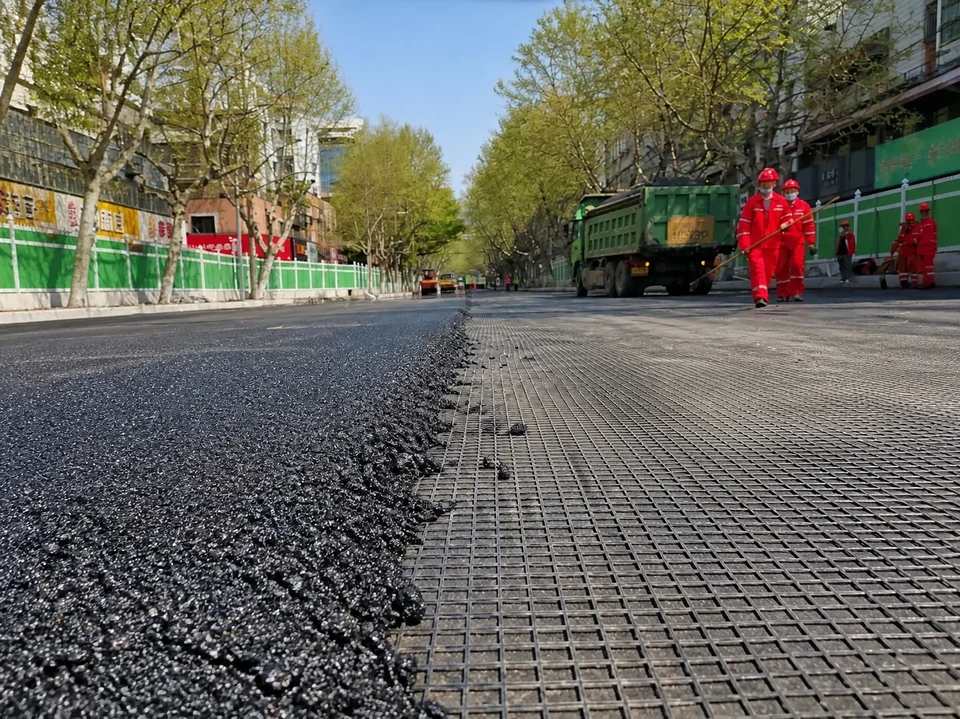
Fiberglass geogrid is commonly installed within asphalt pavement systems to provide low-elongation reinforcement and help manage reflective cracking. Its performance depends on correct layer position, continuous contact and protection during paving.
Confirm the system before installation
Match the roll grade, coating and backing to the approved pavement design and supplied product instructions. VABREN self-adhesive backing helps position the mesh; it does not automatically replace a specified tack coat.
Checkpoints before the asphalt overlay
Surface
Record the repaired area, cleanliness, dryness and weather conditions. Resolve loose material, contamination and uneven contact before laying the grid.
Bonding
Confirm the compatible tack-coat system, application location, specified rate and required condition with the approved method. Record the actual application and any required adhesion check.
Placement
Check roll direction and alignment against the layout. Keep the grid flat and in contact with the surface; use only the fixing or rolling method approved for the supplied product.
Overlaps
Mark longitudinal and transverse joints, measure the actual overlaps and record the drawing reference. Confirm lap direction and details at curves, junctions and repairs before paving.
Release for paving
Check for wrinkles, lifted edges, displacement and damage. Correct defects under the approved method, record the reinspection and obtain the required site approval before covering. Control construction traffic to protect the grid.
Keep a record before covering the grid
Download blank installation record (CSV)
Blank working record only. Enter project-approved requirements and actual observations; this form sets no overlap, application-rate, temperature or acceptance limits and is not a certificate.
Installation sequence
The sequence below is a planning checklist. Confirm tack-coat location and condition, fixing and paving restrictions for the selected system. Staples or nails are options only where the approved product method allows them.
- Repair major failures and clean the surface of dust, water, oil and loose material.
- Confirm that depressions, cracks and joints have been treated according to the pavement design.
- Apply the specified tack coat uniformly and allow it to reach the approved condition.
- Unroll the grid straight, keep it flat and tension only enough to remove wrinkles.
- Fix the material by the approved self-adhesive layer, staples, nails or other method.
- Complete overlaps, inspect the full surface and pave without displacing or damaging the grid.
How much overlap is required?
Longitudinal and transverse overlap must follow the pavement specification and the selected product instructions. Traffic direction, roll direction, curves, junctions and local repairs can change the detail. Do not apply one generic overlap dimension to every project.
Common installation problems
- Wrinkles: often caused by poor alignment, excess tension or paving before the material is secured.
- Grid movement: may result from insufficient fixing, unsuitable tack-coat condition or sharp vehicle turning.
- Poor contact: dust, water, uneven surfaces or incompatible coating can prevent full seating.
- Damage during paving: excessive tyre movement, braking or tracked equipment can tear or shift the grid.
Inquiry checklist
Send the pavement structure, overlay thickness, required tensile grade and mesh, coating or self-adhesive requirement, roll dimensions, overlap detail, quantity and destination.