
Hot-Applied Asphalt Crack Sealant
Hot-poured asphalt-based crack and joint sealant with climate-specific grades for preventive pavement maintenance.
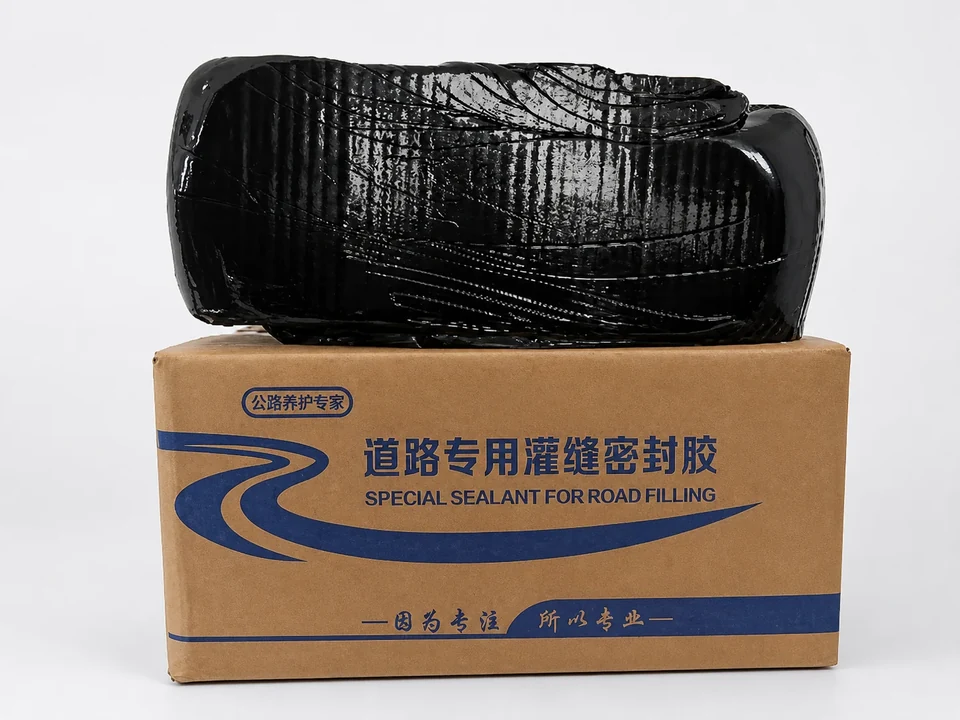

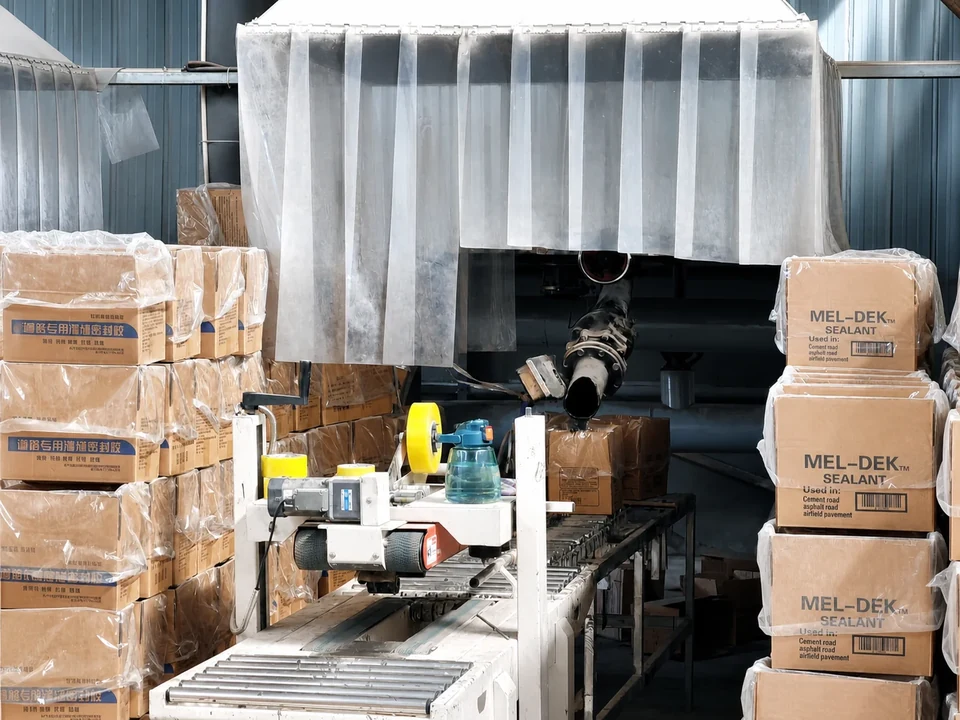


Crack sealant workshop
A wide view of the workshop, with equipment, pallets and boxed materials.
Explore the Workshop in 360°Hot-applied asphalt crack sealant overview
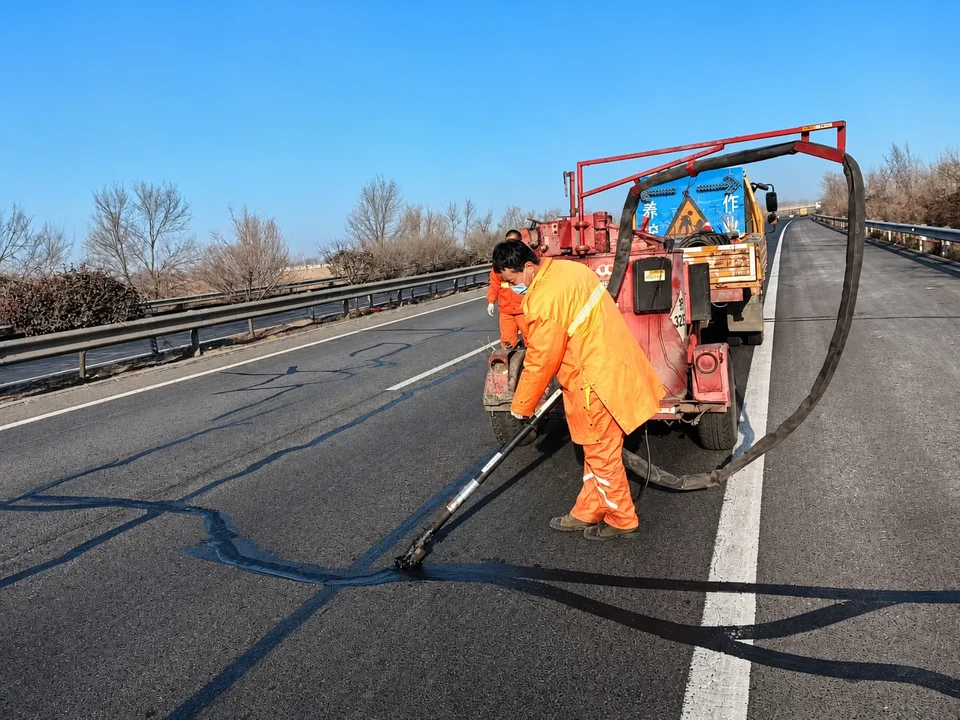
Hot-applied asphalt crack sealant is an asphalt-based compound modified with rubber powder and/or polymers. It is heated into a flowable state and placed into prepared pavement cracks or joints, where it cools into a flexible seal that helps reduce water and incompressible-material entry.
Climate grades from Type I to Type V
JT/T 740—2024 divides the material into five climate types according to the lowest regional air temperature: Type I for areas not below 0°C, Type II for -10°C, Type III for -20°C, Type IV for -30°C and Type V for -40°C. Colder grades require progressively greater low-temperature extension. The correct type should be selected before price comparison.
Key product advantages
- Flowable when heated for continuous filling of routed or prepared cracks and joints.
- Flexible after cooling to accommodate temperature-related pavement movement.
- Climate-specific Type I–V selection framework for different service regions.
- Suitable for preventive maintenance that helps limit water-related pavement deterioration.
- Grade, package size and supporting documents can be reviewed for each project.
Typical applications
Typical uses include longitudinal and transverse cracks in asphalt highways, municipal roads, airport and industrial pavements, parking areas, bridge approaches and joint filling in suitable cement-concrete pavement maintenance works.
Product selection
Selection should consider the lowest service temperature, pavement type, crack or joint width and depth, expected movement, traffic opening time, application equipment and governing project specification. Cone penetration, resilience, viscosity, density, heat-aged softening point and low-temperature extension should be reviewed together rather than selecting by a single value.
Recommended application sequence
- Inspect the crack and determine whether routing or widening is required by the maintenance specification.
- Remove dust, loose particles, vegetation and moisture; the reservoir must be clean and dry before sealing.
- Heat the selected sealant in a thermostatically controlled melter with suitable agitation.
- Apply from the bottom upward at the approved temperature and profile, avoiding trapped air and excessive overbanding.
- Allow the sealant to cool and protect the work from traffic until it can resist tracking or displacement.
Heating and safety notice
The 190°C and 200°C values in JT/T 740—2024 relate to laboratory sample preparation and test conditioning; they are not universal field-kettle instructions. Site heating range, maximum safe temperature, reheating limit, PPE, ventilation and fire precautions must follow the approved grade-specific TDS and SDS. Do not overheat or repeatedly reheat aged material.
Quality-control framework
The standard evaluates cone penetration, compression resilience recovery, viscosity, density, heat-aged softening point and low-temperature extension. Factory inspection items include cone penetration, density and heat-aged softening point. When compliance is required, request the report for the exact supplied type and production batch.
Packaging, transport and storage
Packages should identify the manufacturer, product, production date and mass and include grade-specific instructions. Keep the material dry and protected from fire, heat, moisture and rain; store away from corrosive substances and flammable materials. Packaging and container loading are confirmed with the order.
Information needed for a quotation
Please send the pavement type, crack or joint dimensions, lowest service temperature, required JT/T 740 type or other project standard, estimated quantity, package preference, destination and application equipment. We will confirm the appropriate available grade and documentation before quotation.
Technical specifications
JT/T 740—2024 classification and acceptance limits are shown for product selection. This does not state that every VABREN grade is certified to the standard; the selected type, current TDS and matching test evidence are confirmed with the order.
| Product type | Hot-poured asphalt-based pavement crack and joint sealant |
|---|---|
| Main composition | Asphalt with rubber powder and/or polymer modifiers; formulation varies by climate grade |
| Climate classification | Type I / II / III / IV / V |
| Minimum-air-temperature zones | 0 / -10 / -20 / -30 / -40°C respectively |
| Typical use | Asphalt pavement crack repair and cement-concrete pavement joint filling |
| Supply form | Portioned solid sealant in heat-resistant bags or cartons; package size confirmed per order |
Available specification references
Typical performance indicators
| Property | Type I | Type II | Type III | Type IV | Type V |
|---|---|---|---|---|---|
| Minimum-air-temperature zone | ≥0°C | ≥-10°C | ≥-20°C | ≥-30°C | ≥-40°C |
| Cone penetration · 25°C, 5 s, 150 g (0.1 mm) | ≤70 | 50–90 | 70–110 | 90–150 | 120–180 |
| Compression resilience recovery · 25°C (%) | 30–70 | 30–70 | 30–70 | 30–70 | 30–70 |
| Viscosity · 190°C (Pa·s) | 1–4 | 1–4 | 1–4 | 1–4 | 1–4 |
| Density (g/cm³) | ≤1.50 | ≤1.45 | ≤1.40 | ≤1.35 | ≤1.30 |
| Softening point after 190°C heat aging | ≥90°C | ≥80°C | ≥80°C | ≥80°C | ≥70°C |
| Low-temperature extension after aging | 0°C · 50% · pass | -10°C · 75% · pass | -20°C · 100% · pass | -30°C · 150% · pass | -40°C · 200% · pass |
Common performance requirements
| Low-temperature extension cycles | JT/T 740—2024 | 3 cycles; no crack wider than 3 mm |
|---|---|---|
| Batch reference | JT/T 740—2024 | Same variety and type: 10 t per batch; less than 10 t is one batch |
Pavement type, crack or joint width and depth, lowest service temperature, required JT/T 740 type or project standard, quantity, package size, destination, application equipment and requested test documents.
Report documents
Test report
SIM-20260729-13 · III
Safety data sheet (MSDS)
2026042908E · Road Joint Sealant
Request a specification and quotation
Send your quantity, destination and any project requirements.
Details to include with your inquiry
Send the pavement type, crack or joint width and depth, lowest service temperature, required JT/T 740 type or project standard, quantity, package size, destination and application equipment.
Send project drawings and specifications to info@vabren.com. Include the product name, quantity and destination so we can match your documents to the inquiry.
WhatsApp: +86 133 5538 7555
Customization, production and samples
Made to specification: Most products are made to order according to the required specifications. Send the product, dimensions, grade and quantity for confirmation.
Production cycle: The production cycle for most orders is approximately 15 days. The schedule for the selected product and quantity is confirmed in the quotation. Production time does not include transport to the destination.
Minimum order quantity: The minimum order quantity varies by product and specification. Contact us with your requirements to confirm the quantity for your order.
Samples: Samples are provided free of charge; the customer pays the sample shipping costs. The sample type and size are confirmed according to the product requirements.
Crack sealant selection: match the repair to the pavement
Hot-applied sealant fills prepared cracks or joints to help limit water entry. It does not restore a failed pavement structure. Confirm the repair condition, climate grade and supplied material documents before comparing quotations.
| Site condition | Decision before ordering |
|---|---|
| A defined crack or joint in otherwise serviceable pavement | Review reservoir dimensions, movement, lowest service temperature and the project repair specification. |
| Loose edges, potholes or widespread structural cracking | Assess the pavement repair first. Filling cracks alone does not repair the base or replace missing pavement. |
| Wet or contaminated crack faces | Resolve cleaning and drying before application; do not quote a material grade as a substitute for surface preparation. |
| A specified heating or traffic-opening window | Request the exact grade's current TDS and SDS. Laboratory test temperatures are not universal field heating instructions. |
Estimate volume before converting to mass
For a rectangular reservoir, volume in litres = width in mm × depth in mm × length in m ÷ 1,000. For example, 10 mm × 15 mm × 1,000 m equals 150 litres before allowance for irregular cracks, waste or the specified surface profile. Convert litres to kilograms using the density of the supplied grade; this example is not a guaranteed consumption rate.
Documents to request with the selected grade
- Grade identification and current TDS/SDS, including the approved heating procedure.
- Test evidence for the supplied type and batch when the contract requires compliance.
- Package mass, batch/date identification and order-specific storage instructions.
Use the heating and quantity guide with the selected grade's documents. Compare crack sealing tape and hot-applied sealant, or review the highway application case.
Send crack dimensions, climate, quantity and destination for a grade-specific quotation.