
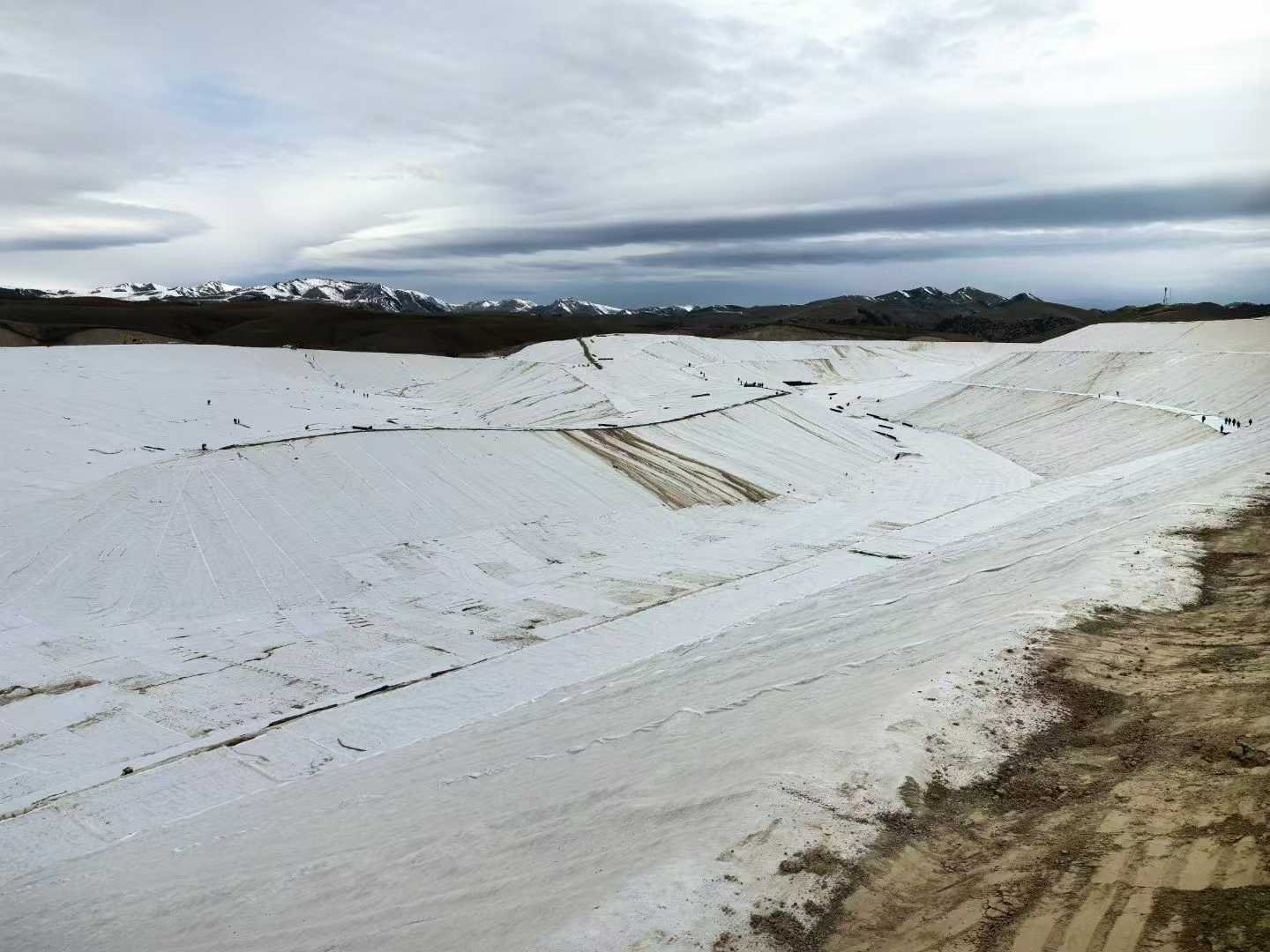
Lay nonwoven geotextile on a prepared surface, close the side and end joints, then place cover without pulling the fabric apart. The lap must remain clean and continuous during that next operation. This VABREN guide covers overlap selection, sewn seams, anchoring checks and roll quantity.
How much should geotextile overlap?
Choose the lap for the application and ground conditions, then measure it across the clean contact between panels. A fabric mass in GSM does not determine the overlap. Side laps, end laps and sewn joints should be identified separately on the layout.
The following construction-reference examples show why one width cannot cover every job. They are planning references, not VABREN grade-specific minimums. The project detail controls the installation; asphalt interlayers and load-transferring reinforcement joints need their own requirements.
| Application | Reference lap example | Check on the project |
|---|---|---|
| Above-water filter layer | 12 in (304.8 mm) | Flow direction, surface contact and cover placement |
| Underwater filter layer | 36 in (914.4 mm) | Deployment control, joint movement and covering sequence |
| Road separation or stabilization | 24 in (609.6 mm), or a sewn joint | Ground support, equipment access and the joint specification |
On pumping or rutted ground, stop and review the placement method. A wider lap can also move if the ground and first cover are unstable. Where a joint must transmit tensile load, use the specified seam construction and seam-strength acceptance; an overlap does not establish that strength.
Geotextile installation: keep the overlap closed
- Prepare the surface. Remove sharp debris, fill local hollows and resolve standing water or unstable areas. Lay the fabric against the ground without bridging a hollow.
- Unroll and align. Match the roll label to the selected material. Avoid dragging, pull out folds and allow the sheet to follow the actual slope.
- Form the joint. Mark the lap on the lower panel, lay the upper panel and measure the remaining contact at straight sections, curves and changes of grade.
- Restrain and check. Use the project restraint or anchor detail. Do not pull the fabric taut across an unsupported area, place pins through another barrier or assume temporary restraint is permanent anchorage.
- Trial the first cover. Work from a supported area with the specified material and lift. Keep construction traffic off exposed fabric; check whether spreading moves the joint before continuing.
Overlap or sewn geotextile seam?
An overlap maintains contact; sewing connects the panels mechanically. Sewing is worth reviewing where large laps are difficult to hold or the design requires seam strength. Prepare the trial seam with the actual fabric, thread and machine. Inspect skipped stitches, edge distance and damaged fabric; release the seam using the project's test and acceptance criteria. Roll tensile strength is not field seam strength.
How to calculate geotextile quantity with overlap
For n parallel strips, roll width W and side lap O:
Covered width = n × W − (n − 1) × O
Example: a 20 m × 50 m rectangle, assumed 6 m rolls and a 0.30 m side lap. Four continuous strips cover 23.10 m and use 1,200 m² of untrimmed fabric for a 1,000 m² rectangle. The cutting plan may reuse offcuts; this is a gross layout allowance, not an optimized order.
The 0.30 m lap is a calculation input, not a construction recommendation. Add end joints, anchorage, slope surface length, repairs and cuts separately. Measure a slope along its surface rather than its horizontal projection.
Calculate a parallel-strip layout
Assumes continuous strips of the entered length. End laps, anchorage and cuts need a separate allowance.
Geotextile installation checklist before covering
- Roll IDs, material grade and panel positions match the submittal.
- Side and end laps remain continuous, with no trapped soil, folds or open edges.
- Sewn seams, anchors and repairs have been checked.
- The first-cover trial shows no joint displacement, puncture or pumping.
- Photos and measurements identify the area released for cover.
Download the geotextile before-cover record (CSV)
If the fabric tears or the ground pumps, stop the operation causing it. Check both the sheet and the underlying ground, agree the repair and record it before covering. A loose patch over failed ground does not correct the cause.
Plan your VABREN geotextile order
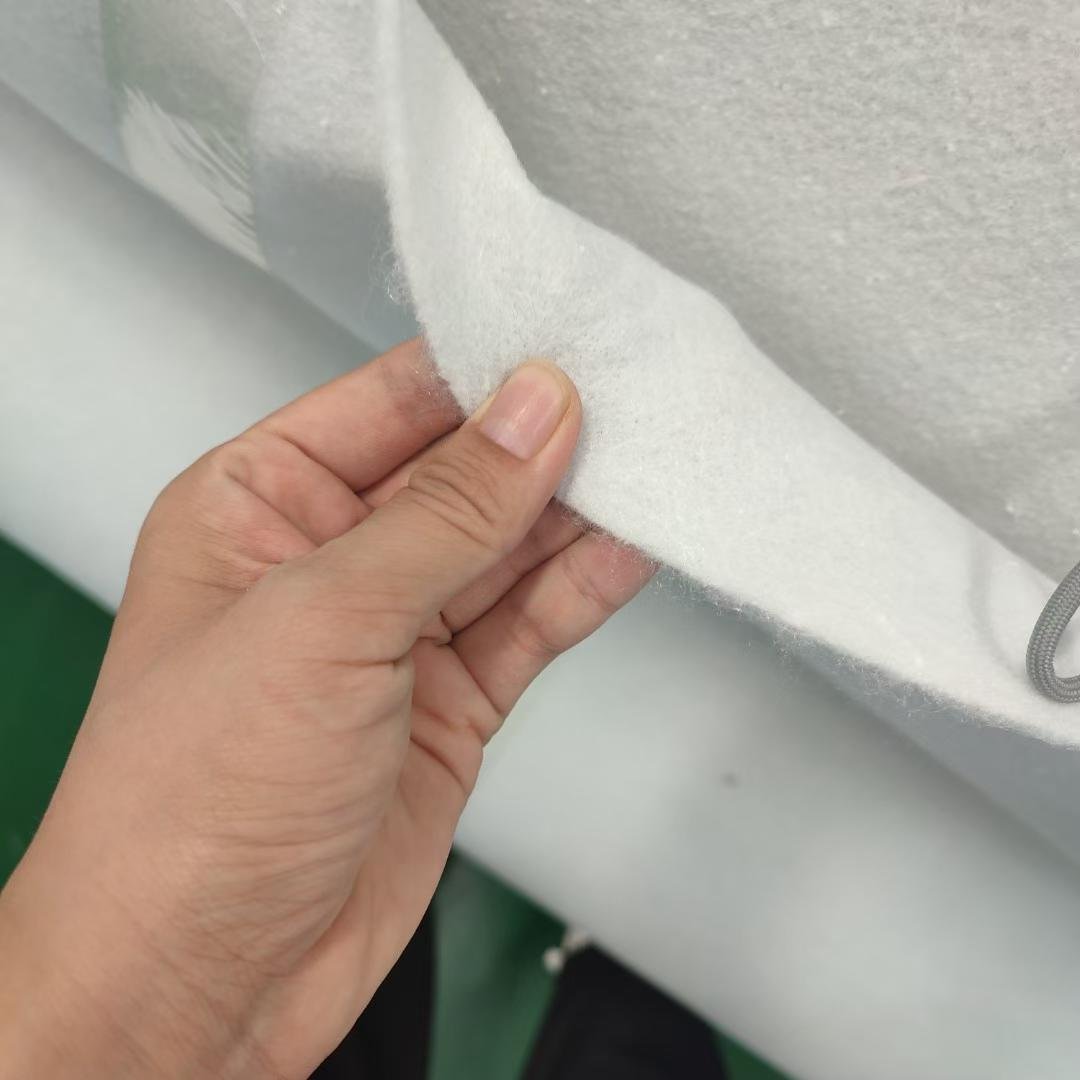
For our short-fiber needle-punched geotextile or filament polyester geotextile, send the function, grade, roll dimensions, joint requirement, ground conditions, quantity and destination. Include the layout when overlap affects the cutting plan.
View the geotextile production line · Choose geotextile properties beyond GSM · Get a Factory Quote