
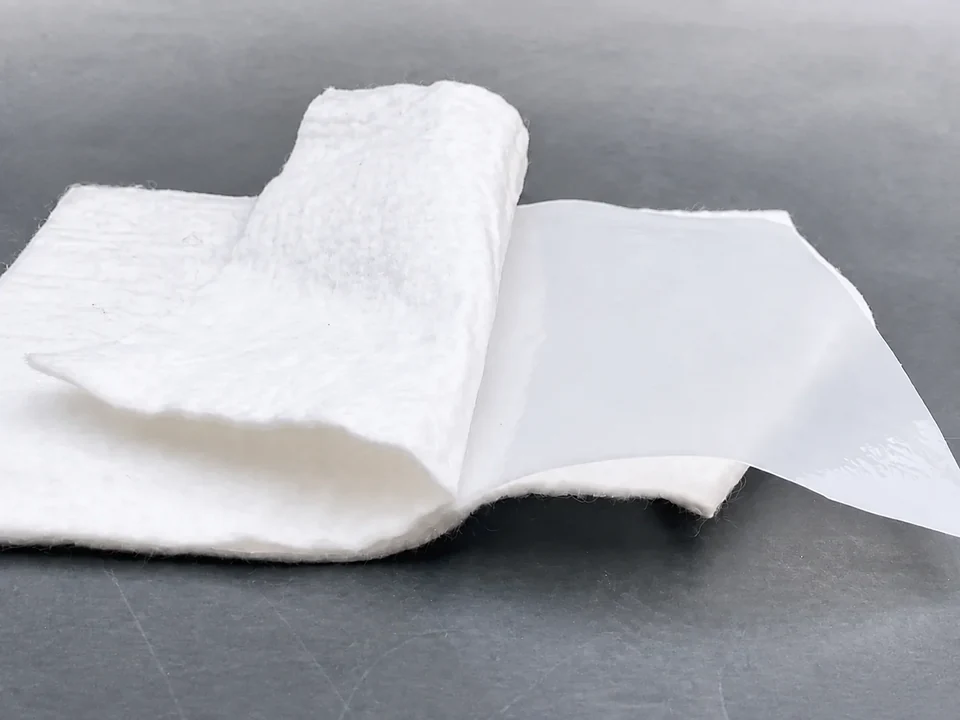
An HDPE geomembrane does not automatically require geotextile underlayment in every project. A protective geotextile is commonly considered when the prepared subgrade contains angular particles, residual irregularities or settlement risks that could create local stress and puncture the liner. The final layer arrangement must follow the project design.
What does the geotextile do beneath a geomembrane?
A suitable nonwoven geotextile can provide cushioning, separation and limited drainage while reducing direct contact between the liner and rough soil or aggregate. It does not compensate for poor subgrade preparation, and sharp objects, roots, voids and unstable areas still need to be removed or corrected.
When should underlayment be considered?
- The subgrade contains granular or angular material that cannot be finished to a sufficiently smooth surface.
- Localized settlement or construction traffic could concentrate stress beneath the liner.
- The geomembrane is installed over concrete, compacted fill or another surface with joints and irregularities.
- The design requires a cushion layer below the liner or a protection layer above it.
- Installation access creates a risk of abrasion or accidental damage before covering.
Is geotextile GSM enough for selection?
No. Mass per unit area is useful for identifying a product grade, but it does not by itself confirm protection performance. Polymer type, thickness, puncture resistance, tensile properties, installation survivability and compatibility with the liner system should be reviewed against the actual substrate and loading conditions.
Geotextile below or above the liner?
Underlayment protects the underside from the prepared foundation. In covered systems, an additional geotextile may be specified above the membrane to reduce damage from cover soil, drainage aggregate, concrete elements or later construction. These layers perform different jobs and should not be treated as interchangeable.
Information needed for a lining recommendation
Send photographs or a description of the substrate, the contained medium, water depth, slope geometry, selected geomembrane thickness, covering material and installation method. This allows the liner and protective geotextile to be reviewed as one system.
View protective nonwoven geotextile