
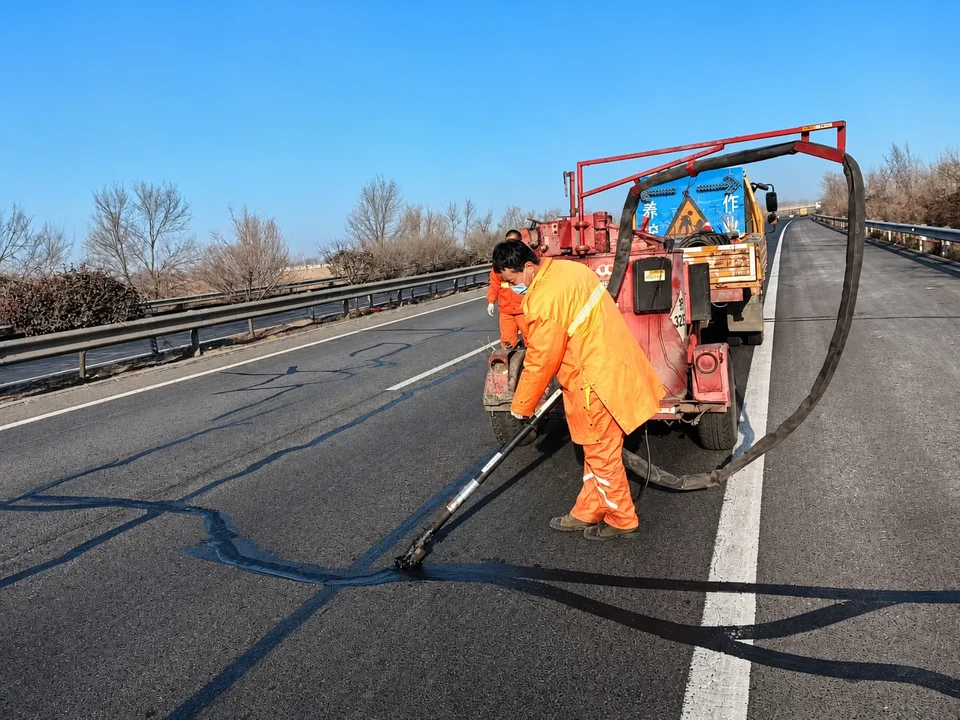
Hot-applied crack sealant must be heated until it reaches the workable range specified for the selected grade, then installed into a clean and dry crack reservoir. There is no universal kettle temperature for every sealant: formulation, climate grade, equipment and manufacturer instructions all affect the permitted range and maximum safe temperature.
What application temperature should be used?
Use the application range and maximum heating temperature on the approved product TDS and package label. A thermostatically controlled melter with suitable agitation should be used, and the displayed kettle temperature should be checked against the actual material condition. The 190°C and 200°C values used in some laboratory test procedures are not automatically field-heating instructions.
Why overheating causes problems
- Extended heating can age the binder and reduce flexibility.
- Exceeding the stated maximum may cause smoking, separation or loss of performance.
- Repeatedly cooling and reheating old material can make application control less reliable.
- Unsafe heating increases burn, fire and fume risks.
Add material in manageable batches, monitor temperature continuously and follow the grade-specific TDS and SDS for PPE, ventilation and fire precautions.
How to calculate crack sealant quantity
For a uniform rectangular reservoir, estimate volume with:
Volume (litres) = crack width (mm) × filling depth (mm) × total length (m) ÷ 1,000
Estimated mass is the calculated volume multiplied by the product density in kg/L. For example, a 10 mm wide, 15 mm deep reservoir over 1,000 m requires about 150 litres before construction allowance. Use the density on the current TDS, then add an allowance for irregular cracks, routing variation, kettle residue and site loss.
Why actual consumption differs
Natural cracks rarely have constant width and depth. Routing profile, backer material, surface overband, intersections, spillage and equipment residue can all change consumption. Measure representative sections and run a trial area before confirming the full project quantity.
Recommended construction sequence
- Inspect and route or widen the crack where required by the maintenance specification.
- Remove dust, loose particles, vegetation and moisture; allow the reservoir to become clean and dry.
- Heat and agitate the sealant within its approved temperature limits.
- Fill continuously from the bottom upward without trapping air or applying excessive overband.
- Protect the seal until it cools sufficiently to resist tracking or displacement.
Information to send with an inquiry
- Pavement type and lowest service temperature
- Average crack width, depth and total length
- Required standard or climate grade
- Melter type and intended construction method
- Package preference, quantity and destination