
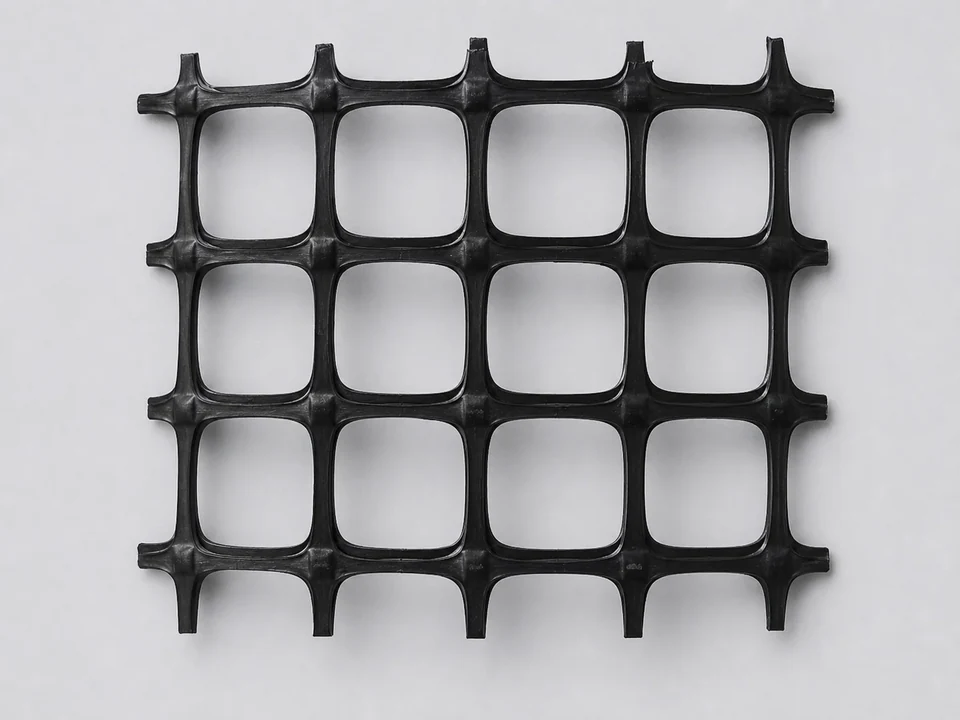
Biaxial plastic geogrid should be selected as part of an aggregate-and-subgrade system. Tensile strength identifies a grade, while aperture geometry affects how aggregate enters and interlocks with the grid. Neither value should be chosen independently.
Start with the project conditions
Confirm subgrade strength and variability, axle or construction load, aggregate grading, base thickness, drainage, design life and installation method. A weak wet subgrade and a stable granular foundation do not require the same reinforcement approach.
How to select tensile strength
Compare the specified tensile property in both machine and cross-machine directions using the required test method. Also review strength at low strain, junction integrity and manufacturing consistency. A higher ultimate number alone does not prove better confinement under the project conditions.
How to select aperture size
The opening must allow suitable aggregate particles to enter and develop interlock without passing through as an unconfined fine material. Compare the grid opening with the actual aggregate particle-size distribution; visual comparison with one stone is not enough.
Turn site information into a comparable request
Keep the ground, aggregate, loading and proposed layer arrangement together when requesting a biaxial geogrid. A grade name or aperture dimension alone leaves the supplier and project designer without the same comparison basis.
Information to attach to the request
- Ground and water
- Attach available subgrade test results with their method, condition and sampling locations. Identify wet or variable areas and the drainage plan; mark missing information for review.
- Loading and section
- State whether the work is a temporary access, working platform or permanent road. Include expected construction or traffic loads, the proposed section and the drawing revision.
- Aggregate and opening
- Provide the actual aggregate grading and material description with the proposed grid opening. Ask for a compatibility review using that grading, rather than choosing from a photograph of one stone.
- Comparable performance data
- Request longitudinal and transverse values, the stated tensile property and test method, relevant low-strain data and junction information. Keep yield, ultimate and low-strain values clearly labelled when comparing offers.
Two illustrative request scenarios
These are planning examples, not completed VABREN projects or grade recommendations.
Access over weak, wet ground
If the subgrade condition and construction loading are still uncertain, request review of those inputs before choosing a grade. Ask the designer to resolve drainage, aggregate placement and any separation or filtration requirement; do not assume the grid alone addresses them.
Road base with an approved section
If the section and aggregate are already approved, compare candidate grids against that same documented basis. Flag differences in test methods, directional properties and opening compatibility for review before accepting an alternative.
The project designer must confirm the selected grade, aperture, layer arrangement and installation requirements. This checklist sets no universal strength, aperture, base-thickness or overlap value.
Installation checks
- Prepare a reasonably level subgrade and address pumping or standing water.
- Roll out the grid flat in the specified direction with the required overlap.
- Place aggregate without driving directly on exposed grid unless the method permits it.
- Maintain the specified first-lift thickness and compact without dragging or folding the grid.
Inquiry checklist
Send the road or platform section, subgrade data, aggregate grading, design load, tensile and aperture requirements, roll size, quantity, standard and destination.