
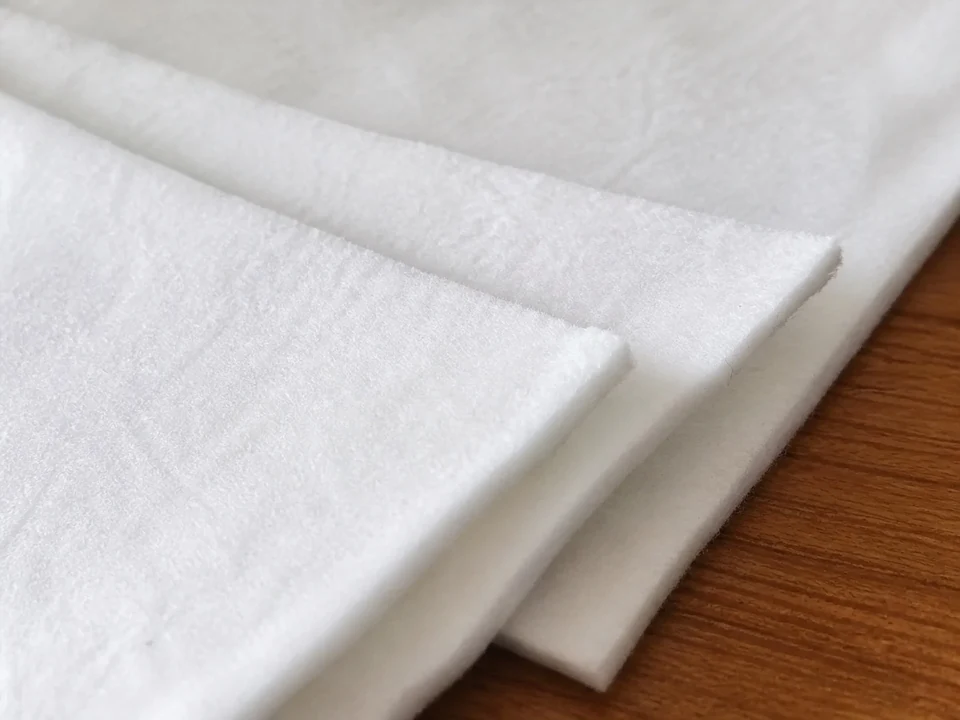
Filament and short-fiber geotextiles are both nonwoven materials used for separation, filtration, drainage and protection, but they are produced from different fiber forms. Filament geotextile uses continuous filaments, while short-fiber geotextile uses staple fibers that are opened, formed into a web and needle-punched. The best option depends on required mechanical and hydraulic properties rather than the product name alone.
Quick comparison
| Selection point | Filament polyester geotextile | Short-fiber needle-punched geotextile |
|---|---|---|
| Fiber structure | Continuous PET filaments | Staple PET or PP fibers, confirmed by grade |
| Manufacturing principle | Continuous filaments formed and needle-punched | Cut fibers opened, web-formed and needle-punched |
| Typical decision focus | Strength, elongation, protection and long continuous-fiber structure | Flexible grade selection for filtration, separation, drainage and cushioning |
| Do not select by | Color or GSM alone; compare the required test properties and polymer | |
Does filament geotextile always have higher strength?
At comparable mass, some continuous-filament PET grades may provide higher mechanical performance than certain staple-fiber products. This is not a universal rule because polymer, mass, needling process and product grade all affect the result. Compare tensile strength, elongation, puncture or CBR resistance and other specified properties on the relevant technical data sheets.
Which is better for filtration and drainage?
Neither construction is automatically better for every soil. Filtration selection should consider characteristic opening size, water permeability or flow, soil particle distribution, clogging risk and installation conditions. A heavier fabric is not automatically a better filter.
Which is suitable for geomembrane protection?
Both product families can be supplied for protective applications when the selected grade provides the required cushioning and puncture resistance. The substrate, cover material, normal stress and geomembrane thickness should be reviewed together. A protection geotextile cannot replace removal of sharp objects or preparation of an unstable foundation.
How should an importer compare quotations?
Confirm that suppliers are quoting the same polymer, mass tolerance, roll dimensions and test requirements. A low price per square metre may reflect a different mass, width, strength grade, roll length or packing arrangement.
Information to include in an inquiry
- Application function: separation, filtration, drainage, protection or reinforcement
- Required polymer: PET or PP
- Mass and required mechanical or hydraulic properties
- Roll width, roll length and packing requirements
- Applicable standard, quantity and destination