
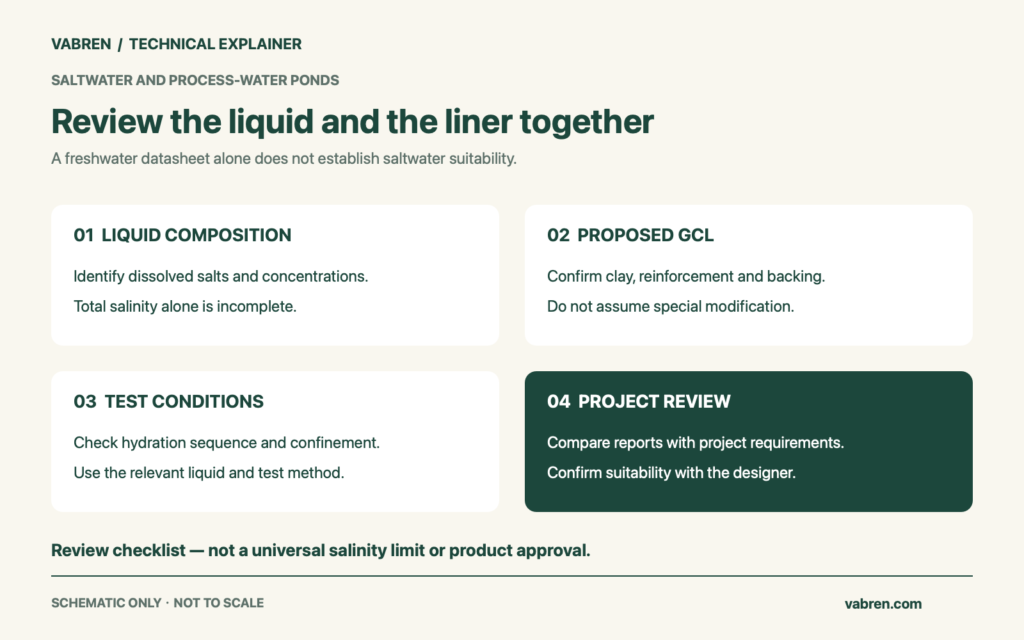
A conventional sodium bentonite geosynthetic clay liner should not be approved for a saltwater pond from a freshwater datasheet alone. Review the actual liquid, the proposed liner and hydraulic test conditions together. Salt composition, hydration sequence and confinement can change the result. This guide explains what to ask for before ordering; it does not set a universal safe salinity limit.
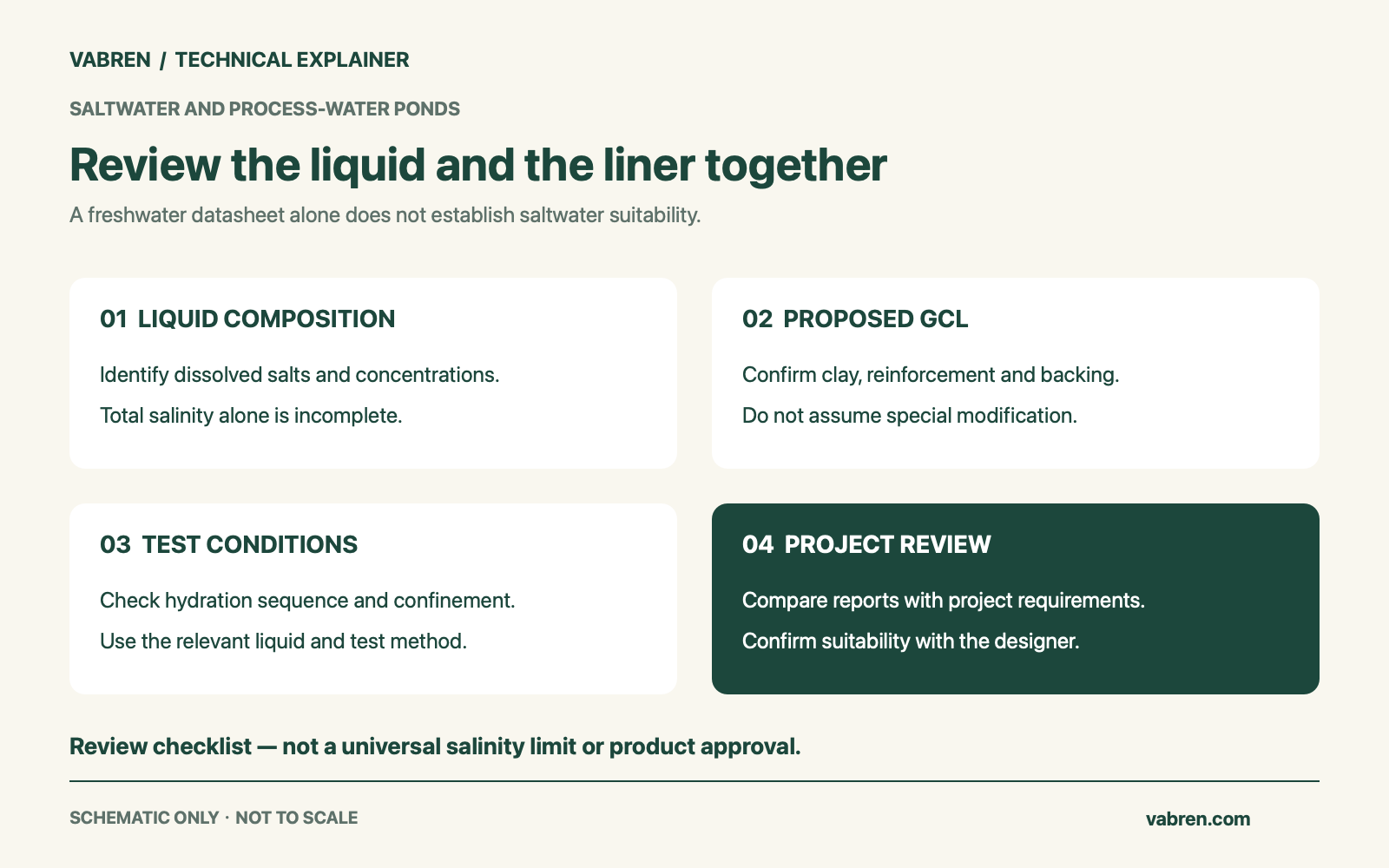
View the full-size saltwater review schematic (purchasing checklist, not a product approval).
Why “saltwater” is not a complete specification
A 2026 study of needle-punched sodium bentonite GCL compared sodium chloride and calcium chloride solutions under different confining pressures. Calcium chloride affected swelling and hydraulic conductivity much more strongly in the tested conditions. The practical lesson is to identify the dissolved salts, rather than judge compatibility from total salinity alone. Those laboratory results are not a performance certificate for another GCL or for your pond. [1]
Prepare these details before requesting a GCL quote
Use this purchasing checklist to connect the site conditions with the proposed material and test plan.
| Information to send | What to clarify |
|---|---|
| Water or process-liquid analysis | Provide the available composition, including sodium and calcium, concentrations and units, not just “saltwater.” Include the sampling date and expected operating changes. |
| First liquid contact | Will the liner hydrate with water before the contained liquid arrives, or contact that liquid first? |
| Liner and cover section | Provide drawings showing the cover, adjoining layers and loading conditions for the designer to define representative confinement. |
| Proposed GCL construction | Identify the product, bentonite type, reinforcement and any membrane backing or modification. |
| Required hydraulic performance | State the project criterion, units, test method and acceptance requirements, where specified. |
For a preliminary inquiry, send the information you have and identify what is still missing. Confirm the final suitability and testing requirements with the project designer before placing the material order.
Compare the test conditions, not only the permeability number
Ask whether the report tested the proposed finished GCL, which liquid was used, how the specimen was hydrated and what stress conditions applied. ASTM D6766 distinguishes water hydration before chemical contact from hydration with the test liquid; these scenarios can produce different hydraulic results. A report using the first sequence does not demonstrate performance for the second. D6766-25 covers GCLs with geotextile backings, and excludes geomembrane, geofilm and polymer-coating backings. Confirm the applicable method and edition for the actual liner construction. [2]
Confinement also matters: the 2026 GCL study found that pressure and solution chemistry interact. A result obtained under a higher confining stress is not automatically representative of a lightly covered pond. Ask the designer and laboratory to agree the relevant conditions instead of copying a pressure from an unrelated report. [1]
Does a swell-index report prove saltwater compatibility?
No. A swell-index result describes the clay response under its stated test conditions. Research on sodium bentonite supports its use in preliminary screening, but that work examined bentonite specimens rather than certifying every finished GCL. [3] ASTM D6141 also distinguishes short-term compatibility screening from performance evaluation. Use screening to help plan the investigation, rather than treating a single swelling value as project approval. [4]
Discuss the specification with VABREN
Start with the VABREN GCL product and specification reference. For a saltwater or process-water inquiry, send the application, available liquid analysis, lining section, required tests, quantity and destination. Clearly identify any polymer modification or membrane backing required by the design; do not assume a conventional sodium bentonite roll has those features.
Request a GCL specification and quotation. Once the material and design are agreed, use the installation and overlap guide to prepare the site work.
Technical references
- [1] Hou et al. (2026), Hydro-mechanical-chemical coupling effects on hydraulic conductivity of geosynthetic clay liners, Chinese Journal of Geotechnical Engineering, 48(3), 608–618.
- [2] ASTM D6766-25: hydraulic properties of GCLs in potentially incompatible aqueous solutions — public scope and significance.
- [3] Yu et al. (2020), Correlation between permeability, swelling, and plasticity of sodium bentonite, Journal of Harbin Institute of Technology, 52(11), 97–106.
- [4] ASTM D6141-18(2022): chemical compatibility screening of GCL clay and index flux — public scope and significance.