
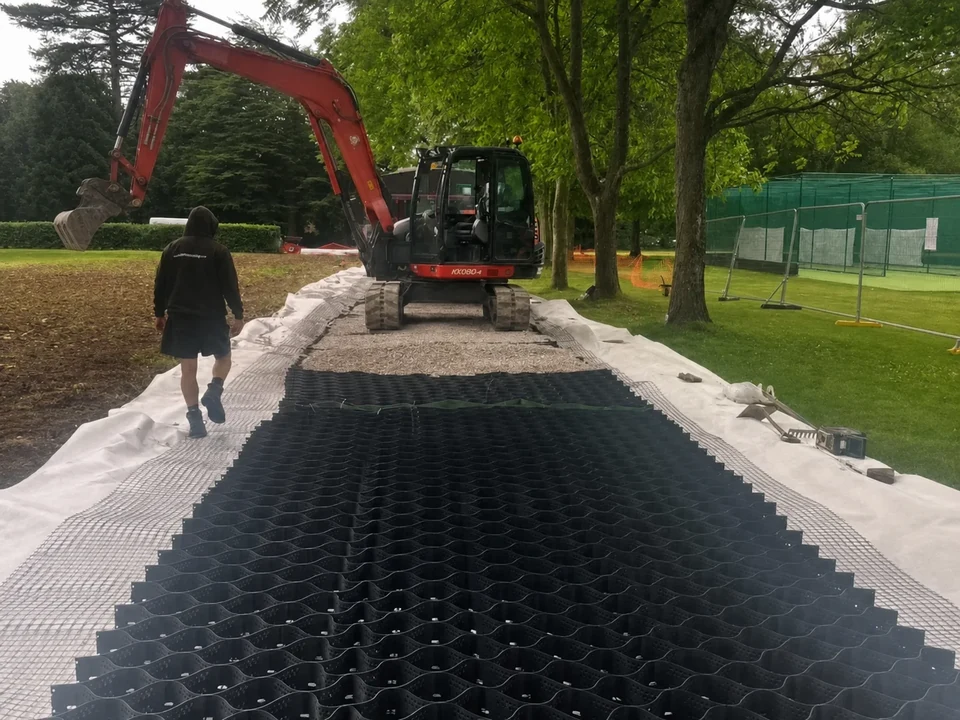
Geogrid and geocell both improve ground, but work differently. Geogrid is a planar grid that interacts with aggregate and carries tensile force; geocell is a three-dimensional system that confines infill.
Selection method
| Point | Geogrid | Geocell |
|---|---|---|
| Structure | Planar grid | 3D cells |
| Mechanism | Interlock and tensile reinforcement | Lateral infill confinement |
| Uses | Road base, platforms, reinforced soil | Load support, slopes, channels |
Compare the required function before comparing products
A road support problem and a slope surface-retention problem need different comparisons. Use the project brief below with the existing parameter checklist to request alternatives on a common basis.
Three questions for a comparable proposal
- Define the function and the acceptance basis
- State whether the design needs aggregate-layer reinforcement, confinement of surface infill, or both. Identify the approved section and acceptance requirements. Surface erosion control and overall slope stability require separate checks.
- Describe the ground, water and infill
- Provide ground investigation results, moisture and drainage conditions, traffic or slope geometry, infill grading and the proposed placement and compaction method. Flag missing information for the project designer before selecting a grade or cell size.
- Compare complete systems with the same objective
- Keep the required function, loading and site conditions consistent. Review layer arrangement, infill, separation or filtration, drainage, connections and installation access. Geogrid tensile data and geocell junction data measure different properties; one cannot serve as a direct substitute for the other.
Two examples of how the comparison changes
These are illustrative planning examples, not completed VABREN projects or product recommendations.
Road or working platform: compare load-support systems
If the project designer allows alternative systems, compare a geogrid interacting with the specified aggregate against a geocell confining the approved infill. Use the same ground and traffic basis and assess each complete section. Do not assume that either option automatically permits a thinner aggregate layer.
Slope surface: separate infill retention from stability
If the purpose is to retain surface infill, review geocell anchoring, connections, infill and drainage against the slope geometry. That review does not demonstrate overall slope stability. If tensile soil reinforcement is required, the designer must separately verify the reinforcement layout and anchorage; the two products are not interchangeable by appearance.
The project designer confirms the system, dimensions and acceptance criteria. Send the project section and available site data with the enquiry; unknown values should remain identified as unknown.
Parameter checklist
Geogrid: polymer, tensile strength, strain strength, aperture, junction, roll and layer. Geocell: polymer, height, cell size, strip specification, weld spacing and strength, perforation, section size, anchors and infill.
Installation cautions
Both require prepared ground and controlled filling. Expand and anchor geocell before filling; keep geogrid flat and correctly positioned during aggregate placement.
Products and case
Compare biaxial geogrid and HDPE geocell. See the road case.
Frequently asked questions
Can they be used together?
Yes, in a designed system requiring both planar reinforcement and cellular confinement.
Which is better for slopes?
It depends on whether internal reinforcement or surface confinement is required.
Choose the stabilization system
Send section, soil, slope or traffic, infill, function, area and standard.