
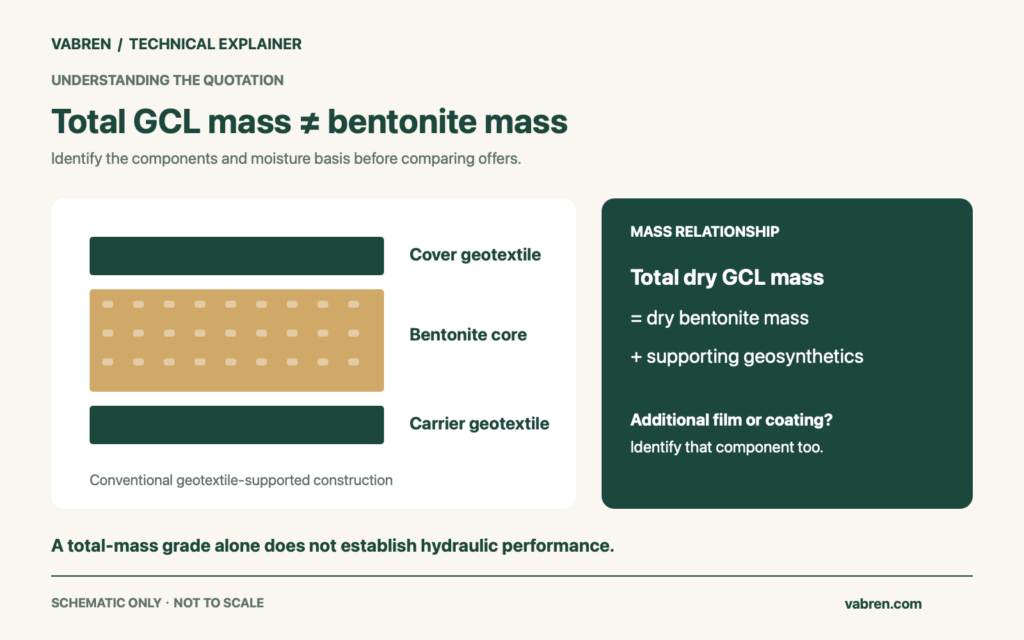
A 5,000 g/m² GCL is not necessarily a liner containing 5,000 g/m² of bentonite. Total liner mass includes its supporting geosynthetics; bentonite mass refers to the clay component. Before comparing prices, confirm which mass is quoted and its moisture basis. Start with the VABREN geosynthetic clay liner product and specification reference, then use the checks below to make competing offers comparable.
View the full-size GCL mass schematic (illustration, not to scale).
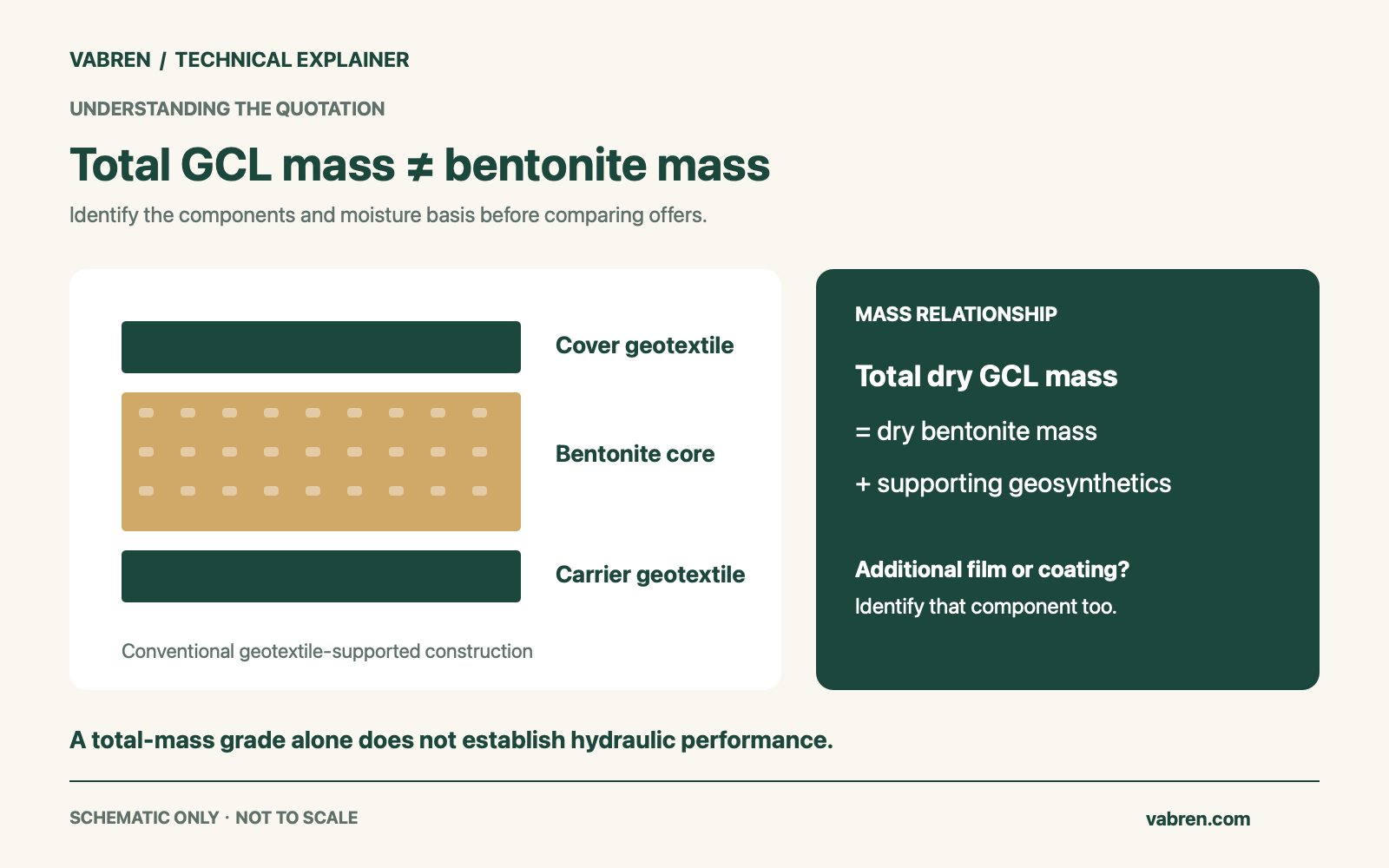
What does GCL mass per unit area include?
For a conventional geotextile-supported liner, total mass includes the bentonite and the carrier and cover geotextiles. A membrane-backed or multicomponent product has additional components to identify. A heavier backing can increase total mass without increasing the amount of bentonite.
Dry bentonite mass and total dry GCL mass therefore answer different questions. ASTM D5993-18(2022) addresses mass per unit area on an approximately zero-moisture basis. Its public scope describes obtaining dry clay mass by deducting the manufacturer’s nominal geosynthetic component masses from the dry composite mass. Ask how the reported value was obtained; do not assume that every supplier physically separates and weighs the clay.
Why two “5,000 g/m²” quotations may differ
Illustrative calculation only: suppose a dry composite has a total mass of 5,000 g/m² and its combined geosynthetic components account for 400 g/m². The remaining clay mass is 4,600 g/m²: 5,000 − 400 = 4,600. These hypothetical values are for illustration only, not a VABREN grade, test result or recommended design.
A second offer stating 5,000 g/m² of dry bentonite is describing a different quantity. Neither offer can be judged against the project requirement until the mass definition, construction and acceptance basis are clear. Also, 5,000 g/m² equals 5.0 kg/m²; changing the unit does not change what is being measured.
Use the same basis when comparing offers
| Quotation item | What to confirm |
|---|---|
| Total GCL mass | Which layers are included, the moisture basis and whether the value is nominal or a specified minimum. |
| Bentonite mass | Clay mass per unit area, moisture basis and the method used to establish it. |
| Geotextiles and backing | Layer construction, polymer, component masses and any film or coating. |
| Acceptance documents | Applicable test methods, sampling, tolerances and reports traceable to the proposed supply. |
| Commercial quantity | Roll width and length, ordered area, overlap allowance, delivery terms and destination. |
Can I check the grade by weighing a delivered roll?
A delivery weight is useful for handling and transport planning, but it does not by itself establish dry bentonite mass. It may include moisture, the roll core and packaging. Check the net material area and the agreed laboratory method before treating a weight calculation as acceptance evidence. Keep total liner mass, dry clay mass and packed shipping weight separate in the order.
Does more mass prove better waterproofing?
Mass alone is not a hydraulic or strength test. VABREN’s specification reference lists mass, hydraulic and mechanical requirements separately. Compare the required performance and test conditions as well as the mass. ASTM D5887/D5887M-23 measures index flux under prescribed conditions for geotextile-backed GCLs; its public scope excludes geomembrane, geofilm and polymer-coated backings. It is not a universal field-performance prediction.
For saline or process water, use the separate GCL saltwater compatibility checklist. For panel placement and covering, see the installation and overlap guide.
Prepare a comparable GCL quotation
Send VABREN your application, project specification, required construction, total and bentonite mass definitions, performance requirements, quantity and destination. If a drawing says only “5,000 g/m² GCL,” ask the specifier which mass is intended before ordering. VABREN’s published mass requirement refers to the composite, not bentonite-only mass; the proposed construction and supporting documents must be confirmed for the order.
Request a GCL specification and quotation.
Technical references
- ASTM D5993-18(2022) — public scope and significance for mass per unit area.
- ASTM D5887/D5887M-23 — public scope and limitations of index-flux testing.