
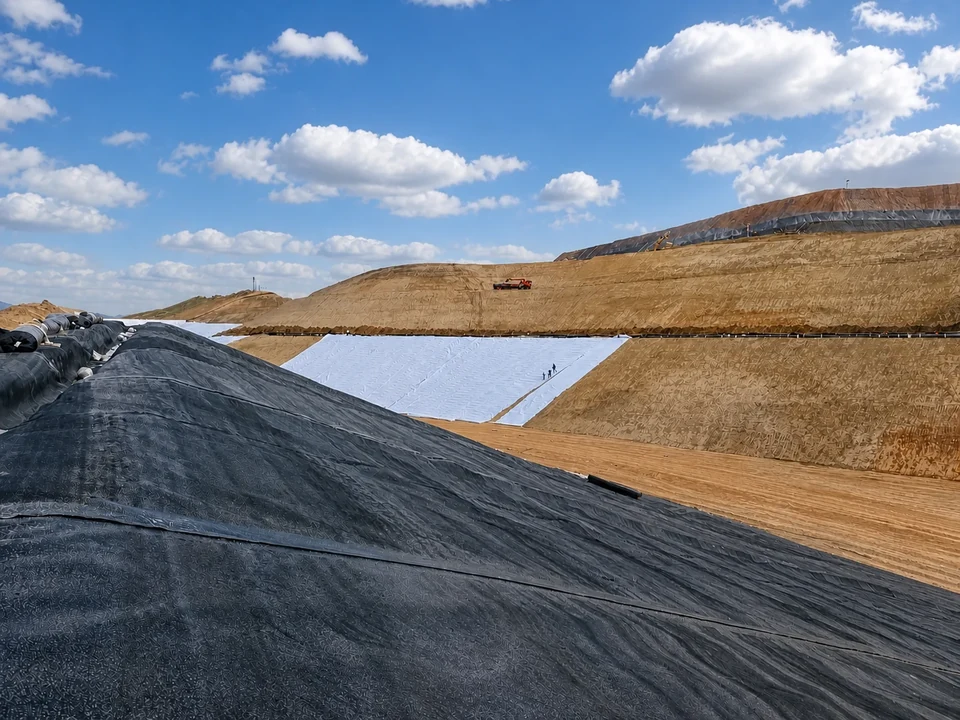
On a slope, smooth versus textured geomembrane is mainly an interface-stability decision. Slope angle alone is not enough; adjacent layers, normal stress, drainage, construction and the required factor of safety matter.
Selection method
- Smooth: floors or interfaces where analysis does not require extra surface interaction.
- Single-textured: texture toward the interface that needs it.
- Double-textured: where both faces interact with adjacent layers.
Match interface tests to the proposed layer stack
Treat each material contact as a separate test request. Texture appearance or asperity height alone cannot establish the shear resistance of the installed lining system.
Map the two faces before requesting a test
- Upper adjacent material: identify the actual soil or geosynthetic.
- Geomembrane: record which face contacts each adjacent material.
- Lower adjacent material: identify the actual soil or geosynthetic.
A marks the upper contact; B marks the lower contact. Add every other contact in the project section. The sketch does not identify a governing slip surface.
Four items to confirm with the test request
- Material pairing and contacting faces
- Identify both materials, product references and contacting faces for each interface. Confirm that the supplied samples match the proposed construction.
- Project conditions represented in the test
- Ask the designer and laboratory to agree normal stresses, moisture or hydration, drainage and specimen preparation representative of the project.
- Results with their reporting basis
- Keep the test method and edition, preparation details, shear stress–displacement curves and observed failure mode with the report. State which peak or post-peak results are being compared and at what displacement.
- Review the complete slope system
- The designer reviews the applicable results with the full slope analysis, drainage, anchorage and construction conditions. Do not transfer a result to a different interface or assume double texture proves stability.
Check the scope of the proposed test method
These method references describe test scope; they do not certify this product. Where GCL is present, ask the designer and laboratory to review both internal and interface shear requirements.
Parameter checklist
- Slope angle, length and transitions
- Layer sequence above and below
- Normal stress, drainage and settlement
- Interface shear test and conditioning
- Asperity height and uniformity
- Core liner properties, seaming edge, roll dimensions and anchors
Installation cautions
Plan downhill deployment, lifting and temporary anchorage. Avoid sliding, excessive wrinkles and equipment damage. Texture does not replace slope analysis, drainage or correct anchorage.
Products and case
Compare smooth and textured HDPE geomembrane, and see the tailings slope case.
Frequently asked questions
Does every slope require textured liner?
No. Select from the layer interfaces and stability evaluation.
Is double-textured always safer?
No. It depends on which interfaces require increased interaction.
Compare surfaces for your slope
Send geometry, layers, cover, standard, test requirement, area and destination.