
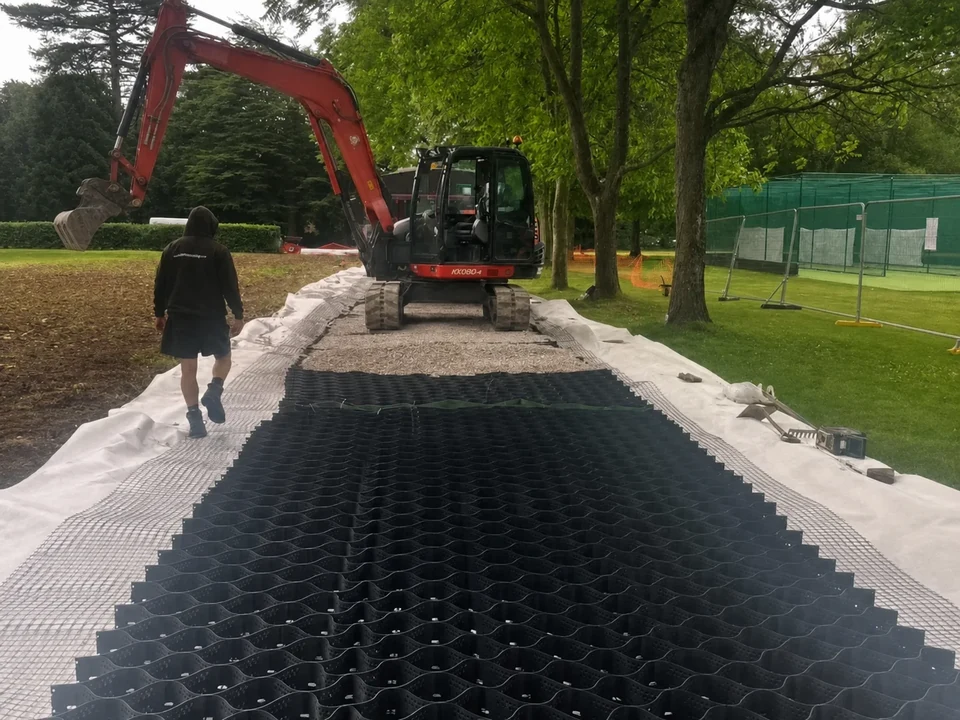
Geocell height and infill material must be selected as one confinement system. A deeper cell can confine a thicker layer, but greater depth alone does not guarantee better performance. Subgrade strength, traffic or hydraulic loading, slope geometry, available fill, drainage and anchoring all affect the final specification.
Quick geocell height reference
| Indicative cell height | Common selection direction | Important project checks |
|---|---|---|
| 50–75 mm | Light erosion control, landscaping and shallow confinement on stable foundations | Surface flow, vegetation, anchoring and fill retention |
| 100 mm | Moderate slope protection, pedestrian areas and light-duty access applications | Subgrade condition, slope angle, load and infill quality |
| 150 mm | Road-base stabilization, working platforms and more demanding confinement | Axle load, weak-subgrade depth, aggregate grading and panel connection |
| 200 mm or project-specific | Very weak foundations, high confinement demand or engineered channel applications | Design calculation, anchorage, drainage and construction method |
These heights are preliminary selection directions, not design recommendations. Available heights, weld spacing, panel dimensions and perforation should be confirmed for the order and checked against the project design.
Which infill works for roads and load support?
Well-graded crushed aggregate is commonly considered for trafficked surfaces because angular particles interlock and the confined layer can distribute load. Sand or locally available granular fill may be suitable under defined conditions, but moisture sensitivity, particle grading, compaction and drainage must be reviewed. The cell should be filled completely and normally covered by the specified overfill rather than left exposed to direct vehicle contact.
Which infill works on vegetated slopes?
Topsoil or an engineered soil mixture can be used where vegetation and surface erosion control are required. The soil must support the selected plants while remaining stable inside the cells. Slope angle, rainfall, runoff path, irrigation, seed or turf system, anchoring and establishment-period protection should be planned together.
Which infill works in channels?
Vegetated soil, aggregate or concrete may be considered depending on expected water velocity, duration of flow, abrasion and maintenance access. Selecting concrete only because it is heavy can create a rigid surface that behaves differently from an aggregate- or soil-filled system. Hydraulic design should determine the infill and anchoring arrangement.
Does a steeper slope always require a taller geocell?
No. On slopes, stability also depends on panel orientation, anchors or tendons, connection strength, surface preparation, interface conditions, slope length and the weight and behavior of the infill. Increasing height without checking anchorage and sliding resistance may not solve the design problem.
Information needed for a geocell quotation
- Application: road, working platform, slope, channel or landscaping
- Subgrade condition, slope angle and slope length or design load
- Proposed infill type, grading and local availability
- Required cell height, weld spacing, perforation and expanded panel size
- Anchoring or connection method, quantity and delivery destination