
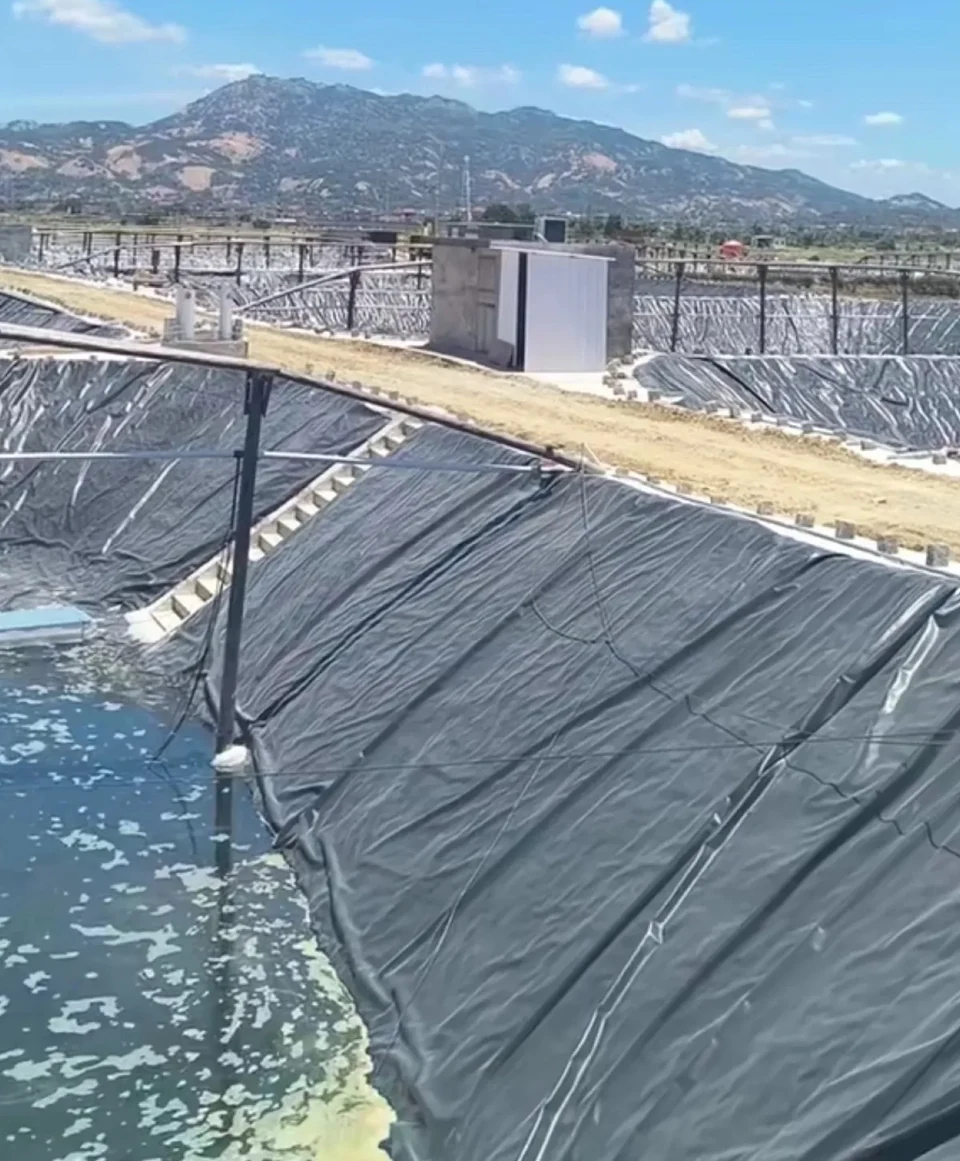
To calculate geomembrane quantity for a pond, include the pond floor, every side slope, perimeter anchoring, panel overlaps and a project-specific installation allowance. Using only the visible water-surface area will normally underestimate the required liner.
Measurements needed before calculation
Record the bottom length (L), bottom width (W), vertical depth (D) and side-slope ratio (z horizontal to 1 vertical). Also provide the crest shape, anchor-trench detail, pipe penetrations, corners and any dividing embankments.
Rectangular pond liner formula
For a regular rectangular pond with equal side slopes, first calculate the slope length: S = D × √(1 + z²). An initial lining area can then be estimated as:
Area ≈ (L × W) + 2 × S × (L + W + 2zD)
This estimates the floor and four sloped sides. It does not yet include anchor trenches, overlaps, penetrations or installation allowance.
Worked pond-liner example
For a pond with a 30 m × 20 m bottom, 2 m depth and 1.5:1 side slopes, the slope length is approximately 3.61 m. The calculated floor-and-slope lining area is approximately 1,004 m². The purchasing quantity must then add the confirmed anchor detail, welding overlaps and a reasonable layout allowance. A preliminary percentage may be used for budgeting, but the final roll plan should be based on the actual drawing.
Why roll width affects the order
Two projects with the same calculated area may require different quantities because roll width, panel direction, seam position and irregular corners affect cutting loss. Wider rolls can reduce the number of field seams, but handling access and welding layout must also be considered.
Send these details for a quotation
- Dimensioned pond sketch or drawing
- Bottom dimensions, depth and side-slope ratio
- Selected thickness and applicable standard
- Number of pond cells and pipe details
- Delivery destination and installation responsibility